Most bathroom countertop failures don’t happen all at once. Slowly they happen: a hairline scratch that starts to trap makeup residue, a seam that spreads with every heavy blow-dryer that lands on it, a faint haze that builds up under styling product spray for months before anyone sees it.
At MN Stoneworks, we help homeowners recognize these warning signs before a countertop reaches that point of no return.
This guide moves through the generalities and examines the real properties, hardness ratings, porosity, and heat limits that distinguish a countertop designed to last from one that can’t handle everyday life. We look in detail at quartz, granite, solid surface, and porcelain, then break down the finishes and edge profiles that extend a surface’s working life.
Why Durability Matters in Bathroom Countertop Design
A bathroom countertop faces more repeated stress in a single week than most kitchen surfaces face in a month: hot tools, acidic skincare products, standing water, and constant contact. Choosing without understanding durable bathroom countertop materials almost guarantees a problem down the line. Unsealed, porous stone left in contact with water can begin absorbing moisture within hours, and once minerals settle into that stone, the staining is often permanent.
A broken seam near a sink allows water to get into the cabinetry below. That moisture can cause wood to swell or mold to grow in a matter of weeks. Getting the material decision right is not cosmetic. It also protects everything under the counter.
What Makes a Bathroom Countertop Truly Durable?
Durability isn’t a single property; it’s four resistances working together, and a countertop is only as strong as its weakest one.
1. Water and Moisture Resistance
Granite typically absorbs between 0.5% and 1% of its weight in water if left unsealed, which is enough to allow gradual staining around faucets and soap dishes. Engineered quartz, by contrast, is effectively a non-porous countertop material, since its manufacturing process leaves almost no open surface structure for water to enter. That difference is why moisture-resistant bathroom countertops built from quartz rarely need resealing, while natural stone does.
2. Scratch and Impact Resistance
The Mohs hardness scale runs from 1 (talc) to 10 (diamond), and it’s the standard reference for how well a material resists scratching. Granite and quartz both fall around 6 to 7, porcelain reaches 7 to 8, and solid surface acrylic sits closer to 3. That gap explains why scratch-resistant bathroom surfaces made from stone or porcelain hold their finish for decades, while softer materials show fine scuffing much sooner under jewelry, hairbrushes, and daily contact.
3. Stain and Chemical Resistance
Acidic skincare products, hair dye, and mouthwash all sit on bathroom counters regularly, and they don’t treat every material equally. Stain-resistant vanity countertops with low porosity resist these substances almost entirely, while porous, unsealed stone can etch or discolor permanently when acids sit too long.
4. Heat Tolerance for Styling Tools
Curling irons commonly reach 350–450°F, and it’s common for them to land directly on the counter. Quartz contains 7–10% polyester resin holding the ground stone together, and that resin can scorch at sustained high heat, leaving a yellow or brown burn mark that cannot be polished out. Porcelain, fired above 2,200°F during manufacturing, isn’t affected by that same risk, making it one of the more reliably heat-resistant bathroom countertop options on the market.
Once quartz scorches from direct heat contact, the resin damage is permanent; no amount of polishing restores the original finish.
Best Durable Materials for Busy Bathroom Countertops
Each material has a different answer to the durability equation, which is also based on how the bathroom gets used on any given day.
1. Quartz: The Best All-Around Low-Maintenance Option
Quartz bathroom countertops are made from roughly 90–93% ground natural quartz bound with 7–10% resins and pigments, producing a dense, engineered stone bathroom vanity surface with a Mohs hardness near 7. Because the material is manufactured under pressure rather than quarried, it never needs sealing. Polished quartz countertops also keep their shine far longer than natural stone, since there’s no porous texture for grime to settle into.
2. Granite: Natural Strength with Timeless Appeal
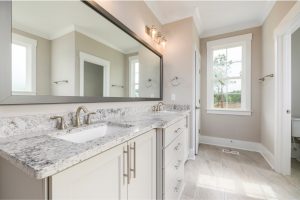
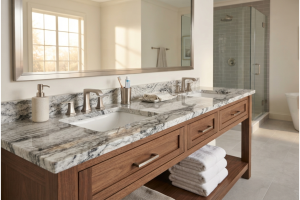
Granite bathroom vanity tops have a Mohs hardness rating of 6 to 7 and real one-of-a-kind veining, as no two slabs are alike. Its 0.5–1% porosity means it benefits from resealing roughly once a year, but with that light upkeep, granite remains one of the long-lasting bathroom vanity surfaces homeowners can choose, often outlasting the cabinetry it sits on.
3. Solid Surface Countertops
Solid surface vanity countertops, made from acrylic or polyester resin, can be thermoformed into a single seamless piece with the sink integrated directly into the counter. That eliminates one of the most common failure points in any bathroom: the seam where water pools and bacteria collect. It is less hard, which means that light scratches happen more easily but can usually be sanded out instead of replaced.
4. Porcelain Countertops
Porcelain bathroom countertops are fired at temperatures exceeding 2,200°F, a process called sintering that fuses the material at a molecular level. The result is near-zero water absorption, a Mohs hardness of 7 to 8, and complete resistance to UV fading, making porcelain a strong candidate among luxury bathroom countertop materials for bright, sunlit bathrooms.
Material Comparison: Which Countertop Fits Your Lifestyle?
This bathroom vanity material comparison shows how each option performs on the factors that matter most day-to-day.
| Material | Mohs Hardness | Porosity | Sealing Required | Heat Behavior |
| Quartz | ~7 | Near zero | Never | Resin can scorch permanently |
| Granite | 6–7 | 0.5–1% | Annually | Excellent, no scorching |
| Solid Surface | ~3 | Very low | Never | Can scorch, but repairable |
| Porcelain | 7–8 | Under 0.1% | Never | Unaffected by direct heat |
For households where multiple people share one bathroom each morning, quartz and porcelain typically offer the strongest bathroom sink countertop durability without maintenance obligations, making either a genuine best countertop for busy bathrooms pick.
Choosing the Right Finish for Long-Term Performance
The material is only half the story; how it’s finished and formed determines how gracefully it ages.
1. Polished vs. Honed Finishes
A polished finish reflects light, cleans easily with a wipe, but also shows fine scratches more easily on its shiny background. A honed granite bathroom surface carries a matte texture that disguises those same scratches and minor water spots, though its slightly more open texture can call for more frequent sealing.
2. Edge Profiles That Reduce Chipping
Sharp, squared edges are striking, but concentrate impact into one weak spot. Eased, bullnose, and beveled edges distribute the same impact over a larger surface, which can help prevent chipping in a bathroom where towels, brushes, and bottles are constantly brushing against the edge of the counter.
3. Color Choices That Hide Everyday Wear
A solid white surface reveals a water spot within seconds; a speckled or veined pattern can hide that same spot indefinitely. For family bathroom countertop ideas where several people use the same vanity, patterned surfaces disguise toothpaste residue and hard-water marks far more effectively than a flat, uniform color.
Common Mistakes to Avoid When Selecting Bathroom Countertops
A few recurring missteps quietly shorten a countertop’s lifespan:
- Skipping resealing schedules on natural stone, which allows moisture to penetrate and stain permanently
- Choosing a thinner slab to cut corners, which raises the risk of cracking around sink and faucet cutouts
- Ignoring edge profile, leaving sharp corners exposed to chipping from daily contact
- Using abrasive or bleach-based cleaners, which dull polished finishes faster than normal wear
- Placing seams too close to the sink, where water exposure is heaviest and failure happens soonest
Invest in a Bathroom Countertop Built for Everyday Life
A bathroom countertop should be judged on how it performs after years of real use, not how it photographs on installation day. Understanding hardness ratings, porosity, and heat thresholds turns countertop selection from a guessing game into an informed decision, and it’s the difference between a surface that still looks new after a decade and one that needs replacing after two years.
At MN Stoneworks, we work directly with homeowners in their home or our office to design a countertop solution suited to their space and their taste. Through our established relationships with local granite and quartz suppliers, we offer high-quality stone products backed by product warranties, and our team has fabricated and installed bathroom countertops for homeowners across Auburn, Gig Harbor, Kent, Sammamish, Bellevue, Puyallup, and Seattle, WA.
If you’re ready to choose a bathroom countertop built for your actual daily routine, our team is ready to help. Call us today at 253.397.4785, get in touch through our contact form, or stop by our showroom in Auburn, WA.