A single dropped pot handle, a forgotten trivet, a pan pulled straight from a 425-degree oven; these small, ordinary kitchen moments are exactly when countertop damage happens. Most homeowners don’t think about heat resistance until they see a discolored ring or hairline crack on a surface they once thought was indestructible. By then, the damage is irreversible. Replacing a piece of stone costs a lot more than preventing it ever would have.
At MN Stoneworks, we’ve spent over 15 years fabricating and installing surfaces built to hold up against exactly this kind of everyday cooking stress.
In this blog, you’ll learn what heat resistance actually means on a material level, which stones will perform better or worse than others in real kitchen conditions, and what actually happens chemically and structurally when heat exposure goes wrong. You’ll also find a practical comparison of granite countertops versus quartz countertops, an honest look at heat-resistant countertop materials and heat-resistant worktops, and guidance on matching kitchen countertop heat resistance to your specific cooking style.
What Does Heat Resistance Mean for a Kitchen Countertop?
Heat resistance is not a marketing label, but a measurable property, which depends on the density, mineral structure and thermal conductivity of a material. Granite, formed under intense natural heat and pressure, tends to disperse heat rather than trap it, making it much more resistant to scorching than engineered or resin-bound surfaces.
Is Any Kitchen Countertop Completely Heat-Proof?
No. Even natural stone countertops can develop micro-fractures under extreme, repeated, or sudden temperature swings. “Heat-resistant” means a material tolerates significant heat without immediate damage; it doesn’t mean you’re working with genuinely heat-proof countertops.
Why Heat Resistance Matters in Everyday Home Cooking
This isn’t about occasional accidents. It’s about what your kitchen counter absorbs every single day, meal after meal, for the next 15 to 20 years.
- Protects Your Countertop From Everyday Cooking Heat: One hot pan won’t do much on its own, but it’s the routine of doing this every night that slowly wears a weaker surface down.
- Helps Prevent Discoloration and Surface Damage: Long before a crack ever shows up, you’ll usually notice a dull patch or faint yellowing; that’s the surface telling you it can’t keep pace with regular heat anymore.
- Supports a Busy, High-Use Kitchen: When several burners and the oven are all going at once, more of the countertop is absorbing heat at the same time, and that strain builds up quicker than people realize.
- Provides Peace of Mind During Meal Preparation: There’s also something to be said for not hesitating before you set down a cast-iron skillet.
- Your countertop is a long-term investment, and durable kitchen countertops protect that investment instead of eroding it.
If heat resistance is ignored, the damage isn’t a matter of if; it’s a matter of when.
Which Kitchen Countertop Materials Are Most Heat Resistant?
Not all stone is created equal, and the differences come down to mineral composition.
| Material | Heat Tolerance | Why |
| Quartzite countertops | Excellent | Nearly pure quartz crystal, extremely dense |
| Granite countertops | Excellent | Formed under natural volcanic heat |
| Soapstone countertops | Very Good | High talc content, historically used beside wood stoves |
| Porcelain countertops | Very Good | Kiln-fired at temperatures exceeding 2,000°F |
| Marble countertops | Good | Heat tolerant but softer and more porous |
| Quartz countertops | Moderate | Roughly 90% stone bound with polymer resin |
| Solid surface countertops | Moderate | Acrylic-based, softens under direct high heat |
Granite vs. Quartz: Which Is Better for Hot Pots and Pans?
Both are market leaders, but they behave very differently under real heat.
1. Granite Countertops and Heat Resistance
Granite forms deep underground under temperatures exceeding 1,000°F. That origin gives it a natural ceiling most kitchen heat sources simply never reach, which is why granite countertops Seattle homeowners often choose for high-heat cooking.
2. Quartz Countertops and Heat Resistance
Quartz countertops are a blend of crushed stone and resin binders. That resin can be softened, discolored, or scorched by continued heat of more than about 150°F, or by brief direct contact with something much hotter.
3. Which Should You Choose?
Granite wins on raw heat tolerance. Quartz scores on stain resistance and consistency. The right choice really depends on how often hot cookware actually touches your countertop, not just how the surface looks in a store.
Why You Should Still Use a Trivet on Heat-Resistant Countertops
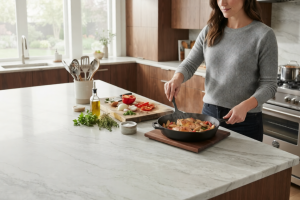
Most homeowners don’t realize that it is rarely the heat that does the damage. It is the rate of change of temperature. It undergoes thermal shock. The same stress that cracks ice when hot water hits it. When you set a 400 °F pan on a countertop at 70 °F, a trivet is more than just a heat shield. It protects against that abrupt change.
What Happens When You Put a Hot Pan Directly on a Countertop?
Choosing countertops for cooking without understanding this distinction is how homeowners end up disappointed, expecting truly heat-proof countertops and getting merely heat-tolerant ones instead. The consequences aren’t always instant, but they are cumulative.
- Thermal shock: The stone expands rapidly at the point of contact, and that sudden movement creates internal stress that tends to start near seams or edges first.
- Discoloration: After enough repeated contact, faint rings can start showing up, and unlike a lot of surface marks, they usually don’t buff out.
- Cracking: This doesn’t happen after one incident; it’s the slow result of extreme or repeated heat wearing down the stone’s structural integrity.
- Resin breakdown: Quartz and solid surface materials are held together with resin, and that resin is what actually scorches or bubbles when things get too hot.
- Voided warranties: Heat damage is excluded from coverage under most manufacturers’ warranties, which means homeowners end up paying for repairs that a warranty won’t cover.
How to Protect Your Kitchen Countertops from Heat Damage
Protecting a heat-resistant kitchen surface takes almost no effort once it becomes habit:
- Use a trivet or cooling rack for anything straight off the stove or out of the oven.
- Never slide hot cookware across the surface.
- Wipe hot spills immediately rather than letting them sit.
- Follow your specific material’s sealing and cleaning schedule.
- Ask your fabricator directly what temperature threshold your chosen stone can handle.
How Heat Resistance Fits Into Choosing the Right Kitchen Countertop
Heat resistance is one factor of many, and you need to balance that against how you actually live in your kitchen.
| Factor | What to Consider |
| Cooking habits | Frequent stovetop use demands higher heat tolerance |
| Maintenance | Porous stones need periodic sealing; denser ones need less |
| Stain resistance | Varies significantly between polished and honed finishes |
| Scratch resistance | Denser materials like quartzite resist knife marks better |
| Moisture resistance | Critical near sinks, dishwashers, and stovetops |
| Design | Veining, color, and finish vary widely by material |
| Long-term value | Durability now prevents replacement costs later |
Best Countertop Materials for Different Types of Home Cooks
Your cooking style should drive this decision more than trends do.
- Everyday family cooking: Granite or quartzite for daily wear and heat exposure
- Frequent bakers: Marble, since it stays naturally cool for pastry work
- Gourmet home cooks: Soapstone or granite for intense, sustained stovetop use
- Home entertainers: Quartz for a clean, consistent finish across large spaces
- Low-maintenance households: Solid surface countertops or quartz to minimize sealing
Heat Resistance in Seattle and Pacific Northwest Kitchens
Our climate doesn’t demand anything unusual from countertops in WA, but our kitchens do. Longer winters mean more cooking on the stovetop, more oven use, and more heat sustained per square foot than more temperate climates usually experience. Homeowners searching for granite countertops in WA or countertops in Seattle are often replacing a surface that simply wasn’t built for how much their kitchen actually gets used, not chasing a trend.
Common Mistakes Homeowners Make When Choosing Countertops
The most expensive countertop regrets come from one of these avoidable errors, and each is simpler to sidestep than to remedy.
- Choosing purely on appearance without factoring in daily heat exposure
- Assuming every stone performs identically, when composition varies dramatically
- Treating “heat-resistant” as “heat-proof” and skipping basic precautions
- Ignoring manufacturer sealing and care guidelines
- Overlooking seams and cutouts, which are more vulnerable points
- Failing to match material to actual cooking frequency and intensity
Choose a Kitchen Countertop Built Around How You Actually Cook
Heat resistance is about mineral density, how well it conducts heat, and how the surface reacts when it is directly exposed to hot cookware. If you don’t do this research, you’ll pay for it later: cracked or discolored surfaces, or a warranty claim denied. Granite countertops, quartzite countertops, and porcelain countertops consistently outperform resin-based options, while quartz and solid surface trade some heat tolerance for lower maintenance and design consistency.
At MN Stoneworks, we don’t just install stone; we help homeowners match material science to real cooking habits, whether that means granite countertops in Kent, kitchen countertops in Bellevue, countertops in Puyallup, or countertops in WA more broadly. With over 15 years of experience and more than 1,250 completed projects throughout the region, our team knows exactly which materials hold up under genuine daily use, not just showroom lighting.
If your current countertop already shows signs of heat damage, or you’re planning a kitchen upgrade and want a surface that won’t let you down, don’t wait for the next accident to force the decision.
Call MN Stoneworks today at 253.397.4785 to schedule your appointment and get a countertop solution built for the way you actually cook.